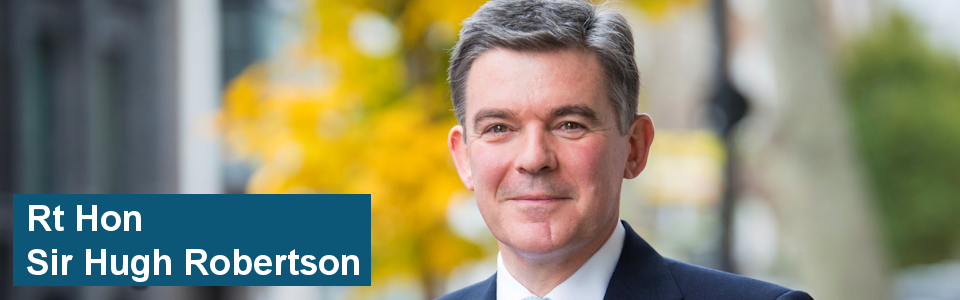
Hugh calls for a single Sports Commission
Hugh Robertson has called for a single Sports Commission to have overall responsibility for sport in the UK.
Earlier this year, I was lucky enough to visit Australia for nine days as a guest of their government as part of the Special Visits programme. Given that Australia is a country with a population one third of our size but one that has already both achieved our Olympic medals target and increased mass participation, the view from the other side of the world is compelling.
If there was one moment that ought to worry all UK sports enthusiasts, it was the meeting I had with one of the most senior figures in Australian sport. He confessed to me that he was unconcerned about the competitive advantage that the UK would gain as a result of the extra money allocated to sport following the Budget because our structure remains unreformed. As he put it ‘We get more bangs for our buck’.
In structural terms, the key to unlocking Australia’s sporting success has been The Australian Sports Commission. This is, in effect, the national sports board, whose simple aim is to ensure that Australia ‘continues to be recognised as the world leader in developing high performance and community sport’. It cuts across government departments and has real bite.
Under the Sports Commission, there is a single body, the Australian Institute of Sport, responsible for the training and development of all elite athletes and coaches. The impact of such a structure has been dramatic. In 1976, the last Olympic Games before the new structure was implemented, Australia came 32nd in the medal table. In both 2000 and 2004, they came fourth.
I believe that there is a strong case for replicating, or at least adapting, this structure in this country. We could introduce a UK Sports Board with overall responsibility for all aspects of sport. It would reach beyond DCMS to access finance and deliver on government objectives in health, education and social cohesion where the budgets dwarf that available inside DCMS.
Underneath it, we need to complete the process, begun last year, of bringing together the existing functions of UK Sport and the English Institute of Sport – and with 2012 only six years away, the work of these two bodies has never been more valuable or important. As UK Sport already does, it should allocate the money and benchmark performance. However, it could also build on the excellent work already done by the EIS in developing the innovative and cutting edge support services necessary to enhance the performance of top athletes. Like The Australian Institute of Sport, it would also help the sport national governing bodies to identify the next generation of athletes and start them on the high performance pathway.
There is, however, one important distinction. I could find nobody in Australia who thought that drug testing should not be the responsibility of a fully independent body. I am fully supportive of the robust line taken by UK Sport in recent months and the issue is one of perception but, as the host city in 2012, I would like us, like Caesar’s wife, to be beyond reproach!
However, in terms of the 2012 agenda, it is equally important that we get more people, both young and old, playing sport in the community. This will require more investment so it is a matter of the very greatest concern that government reforms to the National Lottery have, since 1998, according to figures supplied by The House of Commons Library, taken £3.2bn away from the four original beneficiaries of sport, the arts, heritage and charities. A recent Parliamentary Written Answer from DCMS backed this up showing that the amount of money distributed to sport from The National Lottery has fallen from £394m in 1998 to £264m last year. Some of it has, of course, found its way back through the New Opportunities Fund but, even if sport had only received 25%, £800m would have made a huge amount of difference. I am delighted that we, as a Party, are now committed to putting this right by returning The Lottery to its four original pillars.
UK sports national governing bodies could also learn from their Australian counterparts. I visited the Australian Football League, or Aussie Rules as we know it, and it was most impressive. Under a slimline board, mixing former athletes with business expertise, they have executives responsible for the six key functions of the governing body – in their case, elite athletes, mass participation, schools and youth, coaches and volunteers, umpires and indigenous, or ethnic, programmes. It was a simple, streamlined and modern structure, devoid of the many committees and competing bodies that all too often characterise sport in this country. You could see a pathway from first taking up the game to becoming a high performance athlete. All elite athletes are, also, contractually obliged to spend a set proportion of time coaching youngsters.
All of this is possible in this country. However, we need to start now if we are to maximise the opportunities presented by London 2012 - as Australia did so memorably in Sydney six years ago.